
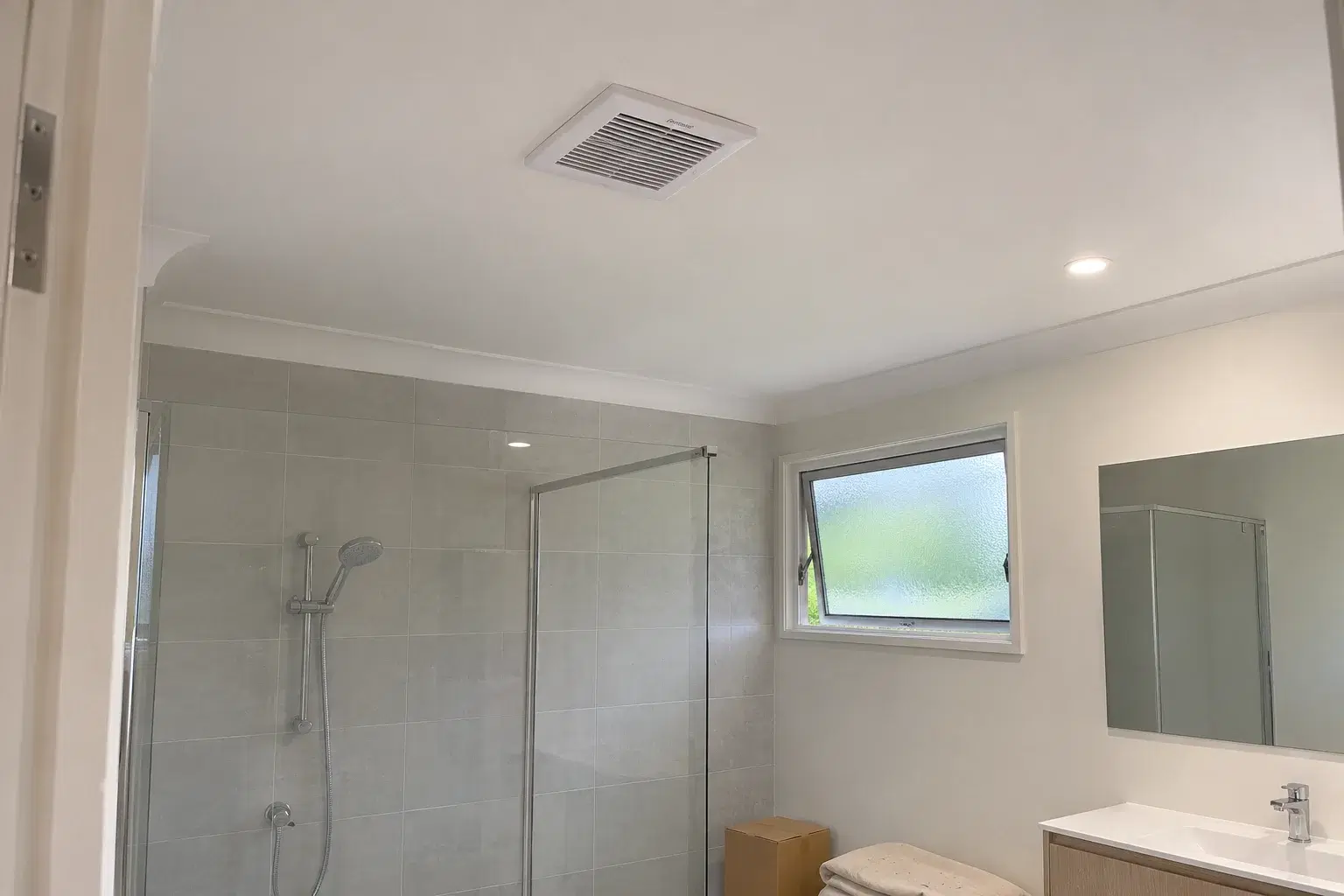
A bathroom exhaust fan should move moist air out of the home. The most useful buying decision starts with the room and the route to outside, then works back to a suitable fan. A large number on the box, a powerful heater or a neat-looking grille does not tell you whether the installed system will clear your shower steam effectively.
Compare the main solutions before choosing a brand
There is no single best exhaust arrangement for every bathroom. Decide whether you need extraction alone or whether heating and lighting also need replacing. Then check what the ceiling, walls and external outlet will allow.
- A dedicated ceiling fan separates ventilation from the choice of light and heater. Check its installed airflow and permitted duct arrangement.
- A three-in-one combines heat, light and exhaust in one fitting. It can be convenient, but one ceiling position has to suit three different jobs.
- An inline system places the fan along a duct, with a separate room grille. It can offer more layout flexibility, but needs suitable space, access and a properly selected motor.
- A wall-mounted fan can suit a room with an appropriate external wall. Check discharge location, weather protection, noise and suitability for that wall construction.
Judge a three-in-one by its extraction as well as its heat
Heating wattage is not a measure of exhaust performance. Check the fan specification separately, including its airflow, duct connection and permitted duct route. Infrared heat lamps primarily warm a person standing beneath them; some other combinations use fan heating, so check which type you are comparing.
The best position for warmth over the drying area may not be the best collection point for steam. In a larger bathroom or an open shower layout, discuss whether a separate appropriately rated extraction point would work better than expecting one central fitting to do everything.
Ask about airflow after the duct is connected
A free-air airflow figure is measured without the resistance of the installed duct system. The useful result in your bathroom depends on the duct length, bends, diameter and outlet as well as the fan. Two products with similar headline figures may behave differently once connected.
For a longer or more restrictive route, ask the installer to check the manufacturer's pressure-performance information. Some centrifugal or mixed-flow designs may suit these conditions better than a basic axial fan, but the actual performance curve and installation requirements matter more than the label.
- Compare like-for-like units: 1 litre per second equals 3.6 cubic metres per hour
- Describe the intended duct route before asking which fan to buy
- Avoid reducing the duct diameter just to reuse an unsuitable connection
- Include the external grille and backdraft device in the assessment
Give the air a way in and a way out
An exhaust fan needs replacement air entering the room. A very tightly sealed door and window can limit that supply. Have the installer assess an appropriate air path rather than assuming the fan alone can solve a sealed-room problem.
The duct should have an appropriate outdoor discharge point and follow the selected fan's installation requirements. A crushed or sagging flexible duct, sharp bends or an obstructed outlet can undermine a good unit. Moving shower moisture into the roof cavity is not the outcome you want.
Cutout sizes are not standard
The visible cover, the hole in the ceiling and the duct outlet are three different measurements. A square fascia may conceal a round cutout. A product advertised with a 150 mm duct connection does not necessarily fit a 150 mm ceiling hole.
For a replacement, have the installer confirm the actual opening and available space safely before ordering. Compare the new model's dimensional drawing with the existing opening, ceiling thickness, framing, installation depth and required clearances. A larger fascia can cover an old outline without making an unsupported or badly sized cutout acceptable.
- Record the existing model and the actual cutout shape and dimensions
- Check body depth, side outlet space and clearance to framing or insulation
- Allow for ceiling repair, repainting or a suitable approved adaptor if needed
- For a new ceiling, select the final model before the hole is cut
- In older bathrooms, assess suspected asbestos-containing ceiling material before any cutting or drilling
What to avoid when shopping on price
A low price does not prove a fan is poor, and a high price does not rescue a bad installation. The risky purchase is one with missing specifications, an unsuitable duct arrangement, awkward maintenance access or a cutout that creates unexpected repair work.
Compare the complete installed cost: fan, duct, external outlet, controls, electrical work and any ceiling repairs. For noise, check the stated test conditions and measurement distance. If those differ, the advertised decibel figures are not a fair direct comparison. Ask what replacement lamps, motors, grilles or drivers can be serviced without replacing the whole unit.
- Avoid choosing on heater wattage or appearance alone
- Be cautious when there is no installation manual or clear dimensional drawing
- Do not assume a cheap replacement will reuse the old hole and duct
- Treat reviews as a prompt for questions, not proof of performance in your room
- Check warranty terms and access to replacement parts before purchase
Make everyday operation easy
A practical fan needs to be used. Discuss straightforward controls, a suitable run-on timer or a humidity-control option, and how the fan will be cleaned. Start extraction when showering and follow the installer and manufacturer's advice about running it afterwards; the useful duration depends on the room and conditions.
If moisture persists, have the system checked rather than immediately buying a bigger unit. Air supply, collection position, duct resistance and outdoor discharge all deserve attention. Condensation on a cold mirror alone is not a reliable airflow test, and persistent dampness can also come from leaks.
Take these questions to your renovation discussion
Bring the bathroom dimensions, shower layout, ceiling height and any information about the existing fan. You do not need to enter the roof space or remove a fitting yourself. An installer can confirm the details that are not safely visible from the room.
- Where will the moist air leave the building?
- What airflow should this fan deliver through the proposed duct?
- How will replacement air enter with the door in normal use?
- Does the selected unit fit the cutout, ceiling depth and clearances?
- Can the heat, light and exhaust functions be controlled sensibly?
- What is included in installation, servicing and any ceiling repair?